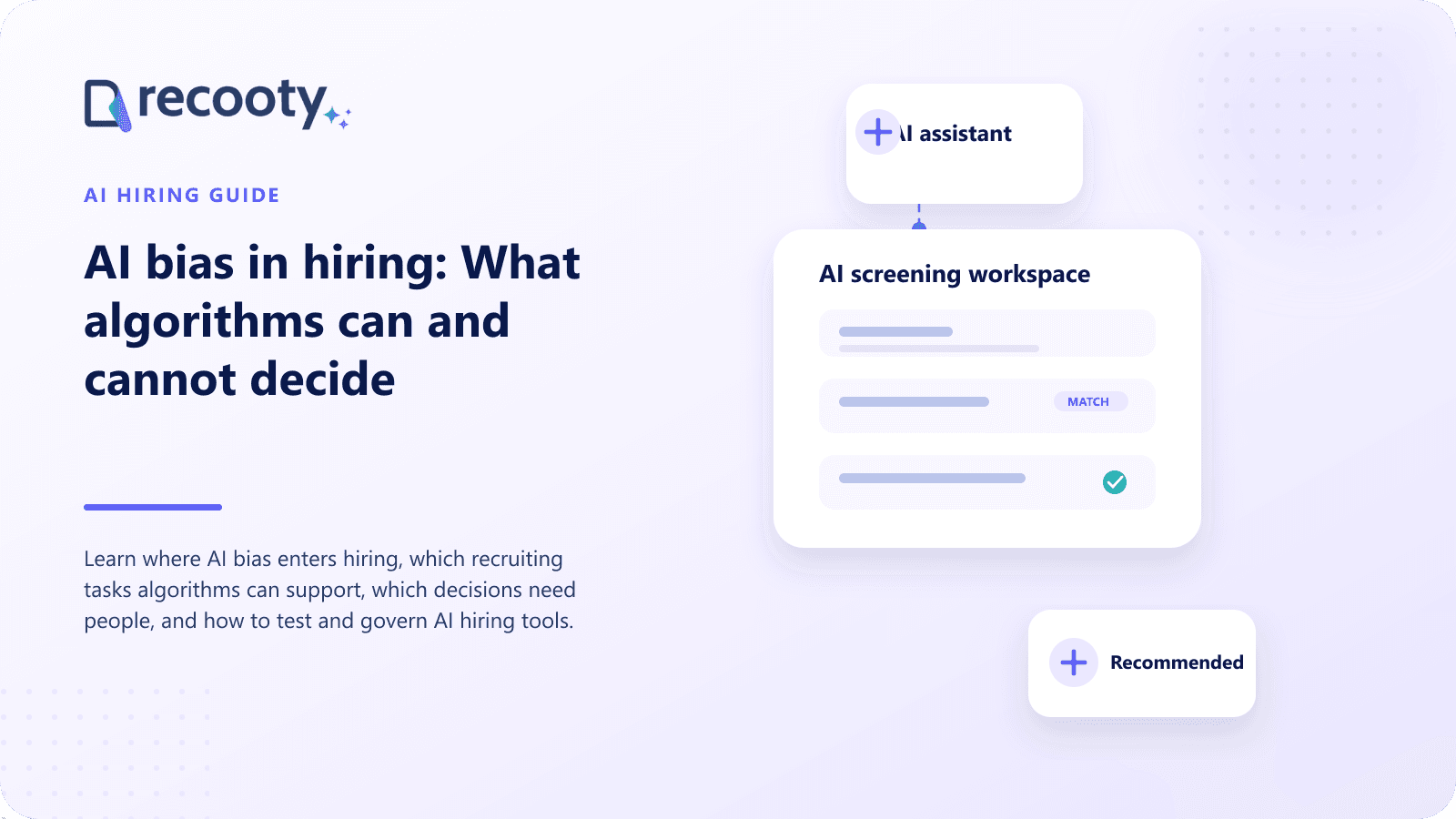
AI bias in hiring: What algorithms can and cannot decide
Learn where AI bias enters hiring, which recruiting tasks algorithms can support, which decisions need people, and how to test and govern AI hiring tools.

CONTENTS
- 00Introduction
- 01Key takeaways
- 02What is algorithmic bias in recruitment?
- 03Where can AI hiring bias enter?
- 04What can AI safely support in hiring?
- 05What should AI not decide alone?
- 06How do you test an AI hiring tool for bias?
- 07Which metrics can reveal uneven outcomes?
- 08What should you ask an AI hiring vendor?
- 09Frequently asked questions about AI hiring bias
For a current comparison, see this guide to AI-powered applicant tracking systems.
AI bias in hiring occurs when an automated tool creates or reinforces unfair differences in candidate treatment or outcomes. Bias can enter through historical data, job criteria, labels, proxies, model design, inaccessible interactions, human use, or a mismatch between the tool and the role.
I would never treat a model score as proof of merit. It is an output produced from selected data and assumptions, and both need review.
Key takeaways
- AI bias can come from data, design, deployment, accessibility, or human interpretation.
- A neutral-looking input may act as a proxy for protected or disadvantaged groups.
- AI can assist with drafting, organization, matching, and pattern detection when people review the output.
- Final hiring decisions and exceptions need accountable human judgment.
- Employers should test outcomes and error rates across relevant groups and over time.
- Explainability, correction, accommodations, documentation, and vendor evidence belong in procurement.
What is algorithmic bias in recruitment?
Algorithmic bias in recruitment is a systematic difference in how a hiring tool represents, scores, ranks, recommends, or treats people. The difference can create harm even when nobody intended to discriminate and the model does not directly use a protected characteristic.
NIST identifies systemic, computational, and human sources of AI bias. Its voluntary AI Risk Management Framework organizes risk work around governance, mapping, measurement, and management.
Hiring adds high stakes because an output can affect access to employment. Accuracy across the full applicant pool is not enough if the tool performs poorly for a smaller group or creates an inaccessible step.
Where can AI hiring bias enter?
If the team is comparing platforms, this list of AI recruiting software can help narrow the shortlist.
Bias can enter before a model runs, inside its calculations, and after it produces an answer. Review the complete hiring workflow instead of examining the algorithm in isolation.
Common sources include:
- Historical hiring data that reflects earlier unequal patterns
- Job descriptions or criteria that do not match actual work
- Training data that underrepresents relevant groups
- Labels based on past manager ratings or employee tenure
- Resume fields that act as proxies for background or opportunity
- Parsing errors across formats, languages, names, or career paths
- Video, voice, or timed interactions that create accessibility barriers
- One score threshold applied without role-specific validation
- Recruiters trusting ranked results more than unranked evidence
- Feedback loops that train future models on earlier model-influenced decisions
A system can also fail through ordinary data quality. The wrong location, missing skill, or misread date may change a recommendation without reflecting any candidate difference the employer meant to assess.
What can AI safely support in hiring?
AI can support tasks where users can inspect the source, check the output, and correct mistakes before harm occurs. Lower-consequence drafting and organization usually allow easier review than automated candidate rejection.
Reasonable assisted uses may include:
- Drafting a job description from approved role information
- Suggesting interview questions tied to stated criteria
- Parsing resumes into fields while retaining the original document
- Finding candidates who match an explicit search
- Explaining similarities and gaps against role requirements
- Drafting candidate emails for recruiter approval
- Summarizing recruiting activity for verification
- Estimating scheduling options across calendars
The person reviewing the output needs enough time and knowledge to disagree. A nominal "human in the loop" adds little if the interface hides reasons or the workload makes rubber-stamping inevitable.
What should AI not decide alone?
AI should not make an unreviewed final decision to hire, reject, promote, or deny opportunity. It should also not infer sensitive traits, personality, emotion, honesty, disability, or future performance from weak or unvalidated signals.
Keep people accountable for:
- Defining job-related criteria
- Deciding which data may be used
- Reviewing accommodations and unusual cases
- Investigating parsing or identity errors
- Interpreting assessments and interview evidence
- Overriding poor recommendations
- Making and communicating final decisions
- Monitoring results after deployment
Legal obligations vary by jurisdiction. Employers should obtain qualified advice for automated employment tools and discrimination law.
How do you test an AI hiring tool for bias?
Testing should examine the intended use, candidate population, performance, group outcomes, accessibility, and human behavior. Repeat it when the model, role, data, workflow, or applicant population changes.
Use this process:
- Define the exact decision or task the tool supports.
- Document inputs, outputs, users, thresholds, and downstream actions.
- Check if criteria are job related and based on available evidence.
- Measure errors and selection outcomes for relevant groups where lawful.
- Test resumes and interactions that vary in format, language, career path, and accessibility needs.
- Review explanations and correction routes with recruiters.
- Confirm candidates have an accommodation or alternative path.
- Monitor overrides, complaints, stage conversion, and unexpected drift.
- Record findings, changes, owners, and review dates.
The U.S. Department of Labor announced an AI and Inclusive Hiring Framework developed with disability advocates and other contributors. It is based on the NIST framework and addresses accessibility and disability-inclusive hiring.
Which metrics can reveal uneven outcomes?
No single fairness metric settles the question. Examine selection rates, false positives, false negatives, missing data, accessibility failures, and performance by role and stage, then interpret them with legal and subject-matter input.
Useful monitoring includes:
- Applications successfully parsed
- Candidates advanced at each stage
- Recommendation and override rates
- Error rates by relevant group
- Accommodation requests and completion
- Candidate withdrawal by tool-assisted stage
- Complaints and correction requests
- Outcome changes after a model or threshold update
Aggregate metrics can hide small groups and intersecting effects. Protect candidate privacy when collecting and analyzing demographic data.
What should you ask an AI hiring vendor?
Ask for evidence about your intended use, not a general statement about responsible AI. Procurement should include product, legal, security, accessibility, recruiting, and data expertise.
Questions include:
- What does the model predict or generate?
- Which fields and sources affect the output?
- What populations and roles were used for testing?
- Which performance and fairness measures are available?
- How are strong and weak match reasons shown?
- Can users correct data and rerun the result?
- Which actions require human approval?
- Can features or automatic actions be disabled?
- How are model changes announced and tested?
- How are candidate data and vendor subprocessors handled?
Recooty provides explainable AI resume scoring and screening, which shows why a candidate appears to be a strong or weak fit. Employers should still define criteria, review explanations, and monitor use within their own process. The guide to AI in applicant tracking systems covers related functions.
Frequently asked questions about AI hiring bias
Can AI remove human bias from hiring?
No. AI may help standardize parts of review or reveal patterns, but it also learns from human-created data and operates inside human-designed processes. Bias can enter through criteria, labels, data, interfaces, or how recruiters use output.
Use measurement and accountability instead of assuming automation is neutral.
Is explainable AI automatically fair?
No. An explanation helps users inspect a result, but a clear explanation can still describe a poor criterion or uneven model. Explainability supports review; it does not replace validation and outcome monitoring.
Check both the reason and the effect.
Can an ATS reject candidates automatically?
Some systems can trigger rejection from configured questions, rules, or scores. Employers should understand the legal and operational consequences before using that function.
Use clear job-related criteria, test edge cases, preserve review routes, and keep accountable people involved in consequential decisions.
How often should AI hiring tools be audited?
Set a regular schedule and repeat review after material changes to the model, data, role, threshold, workflow, or candidate population. Applicable law may impose a specific audit period or notice requirement.
Ongoing monitoring can catch drift between formal audits.
Practical recruiting playbooks, HR tutorials and hiring trends from the team behind Recooty — hiring software for growing teams.