Skills Assessments, Work Samples, and Reference Checks: A Practical Hiring Guide
Learn when to use skills assessments, work samples, and reference checks, how to score them fairly, and how to manage selection evidence in an ATS.

CONTENTS
- 00Introduction
- 01Key takeaways
- 02What is the difference between assessments, work samples, and references?
- 03When should you use a pre-employment skills assessment?
- 04When is a work sample better than a test?
- 05How should employers conduct reference checks?
- 06At what stage should each selection method happen?
- 07How do you score candidate assessments fairly?
- 08How should assessments connect to an ATS?
- 09How can you reduce candidate burden?
- 10Frequently asked questions
Skills assessments measure a defined ability, work samples ask candidates to perform a job-like task, and reference checks gather information from people familiar with a candidate's past work. Used together, they can add evidence beyond resumes and interviews. Each method must remain job-related, consistently administered, accessible, proportionate, and reviewed by people.
Decide what uncertainty each method resolves, use it at the right stage, and remove exercises that do not change decisions.
Key takeaways
- Start with job analysis and define the skill or behavior each selection method measures.
- Work samples often provide direct evidence, but the task should resemble the role and respect candidate time.
- Standardized assessments need validation, consistent administration, security, and accommodation procedures.
- Reference checks work better with structured, job-related questions than informal reputation calls.
- Score evidence against criteria set before reviewing candidates.
- Track completion, results, exceptions, decisions, and retention in the ATS.
What is the difference between assessments, work samples, and references?
The three methods answer different questions. An assessment asks whether the candidate demonstrates a measured capability. A work sample asks how the candidate performs a realistic task. A reference check asks what an informed third party observed in prior work.
| Method | Evidence | Good use | Main risk |
|---|---|---|---|
| Skills assessment | Test score or response pattern | Knowledge, language, technical, cognitive, or role skills | Weak job relevance or inaccessible format |
| Work sample | Job-like output and process | Writing, analysis, coding, design, sales, or operations tasks | Excessive unpaid work or subjective scoring |
| Reference check | Structured account of past performance | Confirming responsibilities and exploring job-related behaviors | Inconsistent questions, bias, or unreliable recall |
| A job description generator can turn responsibilities and requirements into a clear first draft. |
Reviewers need to understand what the evidence means, what it cannot show, and how much weight it receives.
When should you use a pre-employment skills assessment?
Use an assessment when an important capability can be measured before hire but is hard to establish from a resume or interview. Examples include spreadsheet analysis, writing, language proficiency, mechanical reasoning, or regulated-process knowledge.
The EEOC says tests should be necessary, job-related, and nondiscriminatory. Procedures with adverse impact can require evidence of job relevance and business necessity, plus consideration of a less discriminatory alternative.
Before launch, document:
- The job task or outcome connected to the test
- The population and conditions for which it was validated
- The passing score and evidence supporting it
- Administration, identity, retake, and integrity rules
- Required accommodations and an accessible alternative
- Group-outcome monitoring and review ownership
- The period for retaining questions, scores, and reports
A vendor's claim of accuracy does not replace the employer's review of how the test is used for a specific role.
When is a work sample better than a test?
A work sample is often better when candidates can demonstrate the actual work safely in a short exercise. A support candidate might draft a reply, an analyst might interpret a small dataset, and a sales candidate might prepare a discovery-call outline.
Keep tasks close to the role but away from live commercial work. Candidates should not produce usable campaigns, code, designs, or client deliverables without payment. State the time, tools, criteria, deadline, data handling, and compensation.
Good work samples are:
- Short enough to respect candidate time
- Based on fictional, public, or properly sanitized information
- Scored with a rubric defined in advance
- Equivalent in difficulty for candidates in the same process
- Flexible enough to support required accommodations
- Reviewed without irrelevant visual or background cues where possible
Score the output and job-relevant reasoning. Do not reward expensive software or work beyond the stated limit.
How should employers conduct reference checks?
Reference checks should confirm facts and observable behavior through the same questions for comparable candidates. Obtain required permission and let candidates identify appropriate references.
Useful questions include:
- In what capacity and for how long did you work with the candidate?
- What responsibilities did you directly observe?
- How did the candidate handle a job-relevant situation such as prioritization or stakeholder disagreement?
- What conditions helped this person perform well?
- What coaching did you provide, and how did the candidate respond?
- Would you work with this person again in a similar role?
Avoid protected traits, health, family, religion, age, and unrelated personal matters. Define how to handle references that provide only dates and title without penalizing the candidate.
Backchannel checks can produce unverified opinions and uneven treatment when applicants have different networks. Ask counsel to review when they are allowed.
At what stage should each selection method happen?
Place each method as late as practical. A short screen can precede the first interview, a longer sample belongs after mutual interest, and references usually occur near the final stage or conditional offer.
One practical sequence is:
- Screen applications against stated requirements.
- Hold a structured introductory interview.
- Invite shortlisted candidates to a job-related assessment or work sample.
- Run structured interviews focused on remaining evidence gaps.
- Conduct authorized references and other pre-hire checks.
- Review all evidence and document the decision.
If an interview or sample already measures the skill, another test adds dropout without much signal.
How do you score candidate assessments fairly?
Define criteria, behavioral anchors, weighting, and minimum standards before results arrive. Train reviewers with sample responses and require them to cite evidence. Independent scoring before group discussion reduces the chance that the loudest opinion reshapes every rating.
The ATS should distinguish raw vendor results, reviewer scores, notes, exceptions, and the final decision. Do not collapse several measures into one unexplained “fit” number. A high overall score can hide failure on a required capability, while a lower score may reflect an accommodated format that remains fully comparable.
Monitor pass rates, withdrawals, time, accommodations, failures, interviews, offers, hires, and job outcomes. Review relevant groups where lawful, and investigate differences.
How should assessments connect to an ATS?
An ATS integration should invite the right candidate at the correct stage, send approved instructions, record completion, return an interpretable result, and restrict sensitive data. Recruiters should not copy scores between systems by hand.
Test these controls:
- Candidate identity and job mapping
- Consent, notice, and accommodation route
- Expired, late, failed, or repeated attempts
- Score visibility by user role
- Manual review and override reasons
- Status updates without automatic rejection by default
- Retention, deletion, export, and vendor data removal
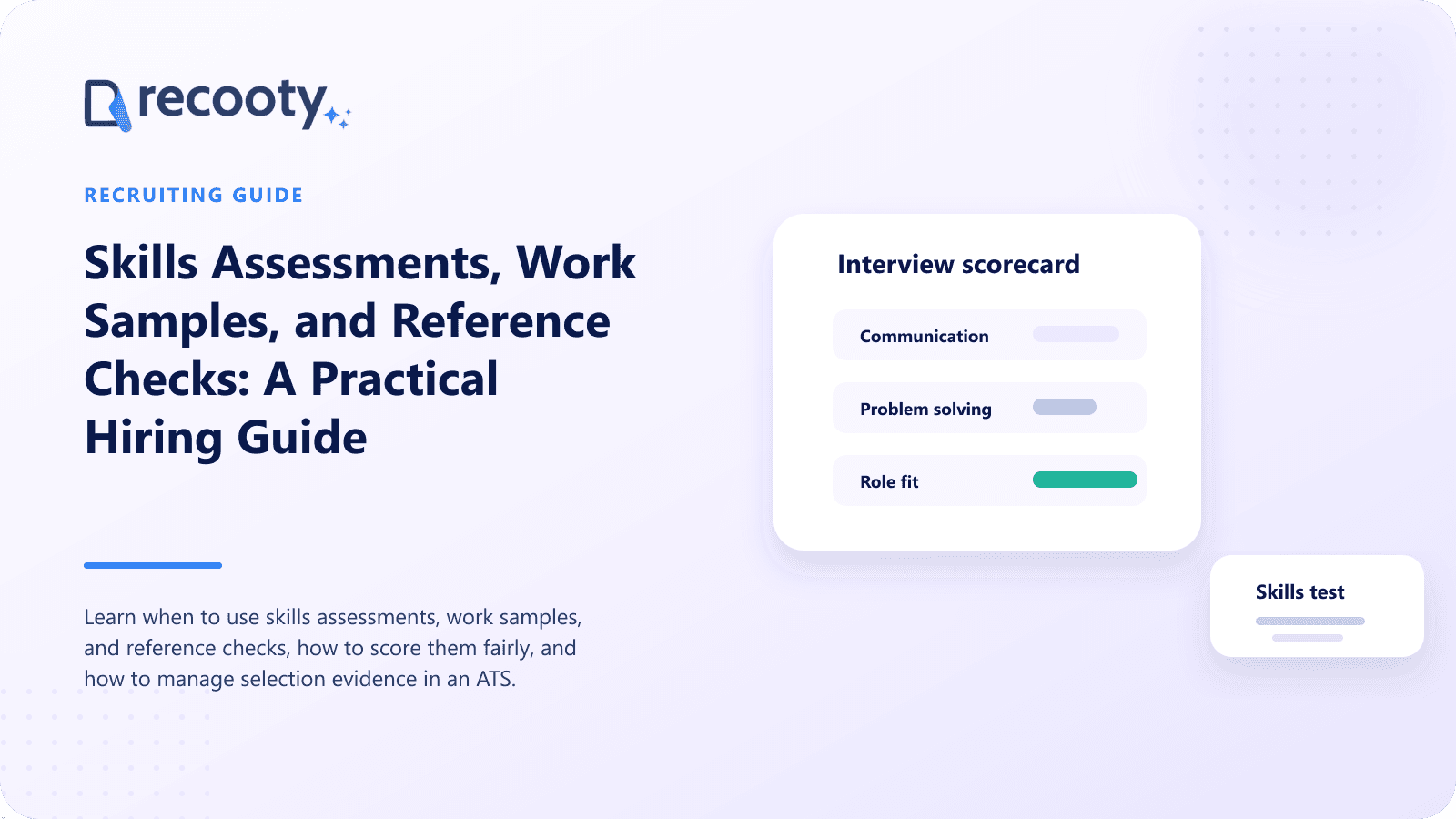
Recooty supports connected pre-hire checks and shared candidate evaluation within its applicant tracking workflow. Teams can use interview scorecards, notes, permissions, and candidate timelines to keep evidence tied to the role and decision.
How can you reduce candidate burden?
Tell candidates why the step exists, how long it should take, what will be assessed, what technology is needed, and when they will hear back. Provide a contact for technical problems and accommodations. Avoid surprise timers and hidden monitoring.
Track abandonment and ask candidates for brief feedback. If qualified people regularly withdraw at the same step, review its length, timing, instructions, accessibility, and value to the final decision.
Frequently asked questions
Are skills assessments legal?
They can be, but legality depends on the test, role, administration, impact, accommodations, jurisdiction, and decision use. Employers should show job relevance, apply procedures consistently, provide required accommodations, monitor outcomes, and obtain legal or industrial-organizational expertise where needed.
Should employers pay candidates for work samples?
Payment may be appropriate or legally required when an exercise takes substantial time or creates usable commercial value. Even when unpaid work is permitted, keep it short, fictional, and clearly separate from live client or production work. Ask local counsel about wage rules.
Can AI score a work sample?
AI can assist reviewers, but it should not be the sole judge. Employers should understand the criteria, test accuracy and group impact, protect candidate data, provide notice where required, handle accommodations, allow human review, and document the final decision.
When should reference checks happen?
Reference checks usually happen after interviews when the employer has a small finalist group, or after a conditional offer where policy and law permit. Tell candidates before contacting references and use consistent, job-related questions.
Practical recruiting playbooks, HR tutorials and hiring trends from the team behind Recooty — hiring software for growing teams.