7 Job Posting Mistakes Costing You Talent (and How To Avoid Them)
Stop losing great job candidates! Learn 7 easy tips to fix common job posting mistakes and create better ads that attract talent.


CONTENTS
- 00Introduction
- 01Key takeaways
- 02Why Avoiding Job Posting Mistakes Is Crucial
- 037 Common Job Posting Mistakes
- Using Unclear Job Titles
- Overly Vague or Complicated Job Descriptions
- Skipping Important Details Like Location and Salary
- Listing Unrealistic or Excessive Qualifications
- Neglecting to Showcase Company Culture
- Not Mentioning the Application Process
- Weak Call-to-Action (CTA)
- 04Best hiring software with AI job description generator and auto-publish to careers page
- AI to improve response rates from candidates: avoid generic outreach
- 05Job posting mistake audit before publishing
- Best OFCCP job posting software for 2026: audit the distribution trail
- 06What strong job-posting guidance adds
- 07Conclusion
- 08Frequently Asked Questions
Most job-posting mistakes are easy to catch before publication. Check the title, daily work, requirements, location, pay, application steps, and follow-up plan from a candidate’s point of view. Then compare the live listing with the version in your hiring system so a clear draft does not become a confusing published ad.
This guide covers seven common mistakes and gives you a short review process for fixing them. It also explains how an applicant tracking system (ATS) and careful use of AI can support the work without replacing human approval.
Key takeaways
- The most expensive job-posting mistakes are usually clarity and trust failures: vague titles, missing pay or location, inflated requirements, unclear work patterns, hidden application effort, and no response after applying.
- Candidates use the job ad to decide whether the role is worth their time. State the work, outcomes, salary or range where appropriate, location, flexibility, requirements, benefits, process, and timeline.
- AI can help draft or audit an advertisement, but it can also invent responsibilities, copy bias from old postings, and make every role sound identical. Human review is required before publishing.
- Keep the ATS, careers page, job board, structured data, and application form aligned. A correct ad in one system can still fail if another system shows an old title or closed role.
- Measure qualified application rate, application completion, source quality, time to first response, candidate feedback, and correction rate instead of counting views alone.
- If you are a covered federal contractor, preserve the approved ad and distribution record and get current compliance advice. Software can support recordkeeping, but it does not transfer the employer’s responsibility.

Why Avoiding Job Posting Mistakes Is Crucial
A clear job post helps qualified candidates decide whether the role fits and helps your team review applications against the same expectations. It also supports your employer brand and can streamline your hiring process when the published details stay accurate.
7 Common Job Posting Mistakes
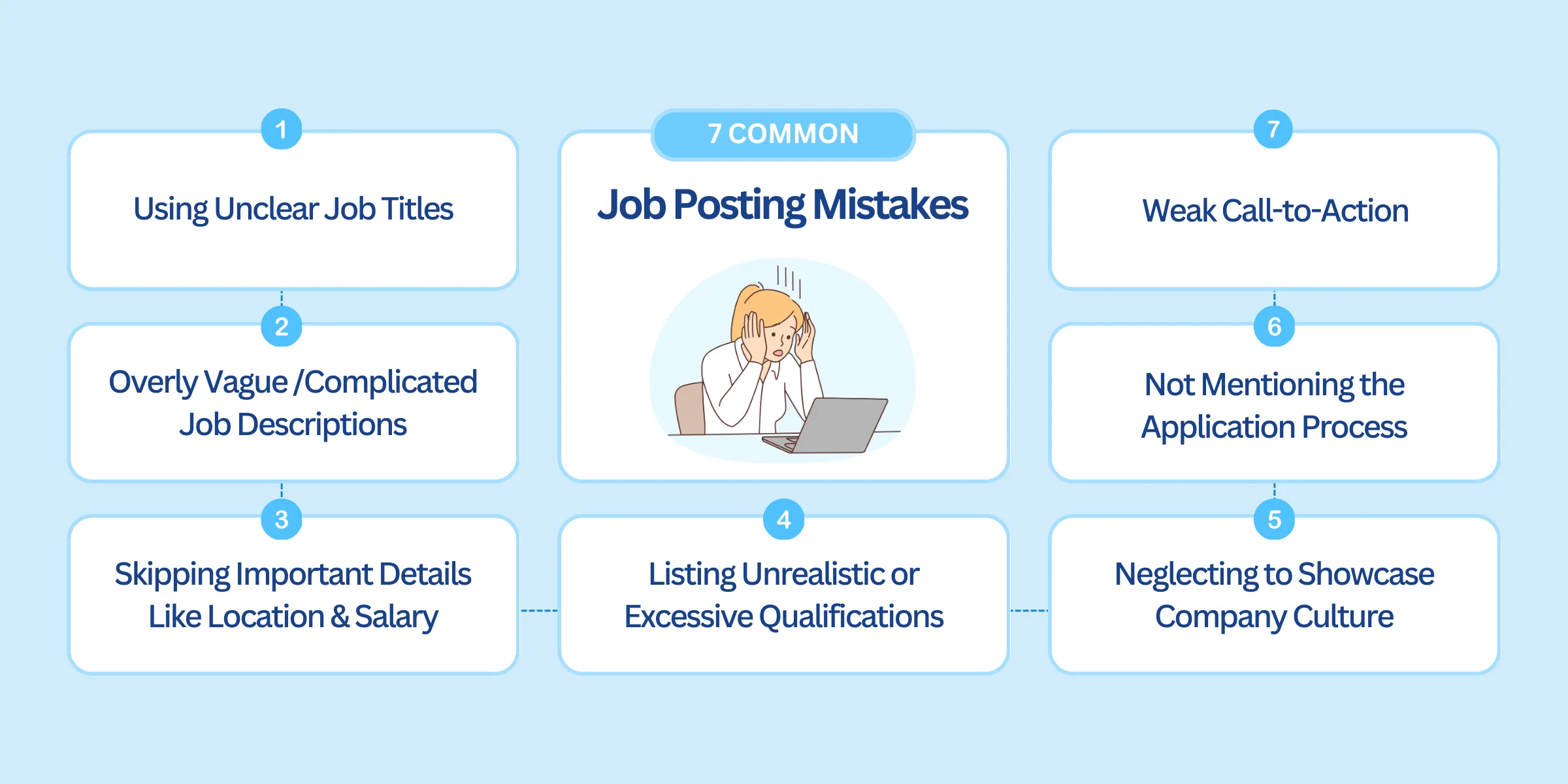
01Using Unclear Job Titles
A suitable title for the job post has an impact on the number of qualified candidates who are likely to apply for the job. Job seekers generally search using specific keywords
found in the industry, if the job doesn’t include them, the chances of potential candidates being able to find you decrease.
Tip: Stick to industry-specific job titles like “Marketing Manager” or “Software Developer.” Avoid vague titles like “Marketing Ninja” that confuse the candidate and hurt the search visibility.
02Overly Vague or Complicated Job Descriptions
A job description needs to be clear about the work and its expectations. If it is vague or filled with jargon, candidates may not understand the role or may decide not to apply. They should be able to find the responsibilities and required qualifications quickly.
Tip: Use bullet points to outline key responsibilities and essential qualifications. Don’t forget to include specifics like tools or software they’ll be using.
You can also use the pre-written templates to create a detailed description that explains the role clearly and concisely.
03Skipping Important Details Like Location and Salary
Skipping key details like job location, salary range, or work benefits can lose you good candidates. People want to know upfront if the job aligns with their expectations for salary and logistics.
Tip: Try to be transparent about the compensation, job location, and any benefits like remote work options or flexible hours or anything. Transparency attracts candidates who are interested in the offer.
04Listing Unrealistic or Excessive Qualifications
Long lists of desired qualifications that are viewed as unrealistic will most likely discourage the right candidates. Stating excessive requirements such as a candidate may only level up if he has 15+ years of practice at mid-level, not only will extend the process of recruitment but could even discourage highly qualified candidates.
Tip: Make sure you distinguish between the must-have qualifications and the nice-to-haves.
05Neglecting to Showcase Company Culture
Candidates make their choices not only based on the particular job but also based on the employer. Without obtaining such crucial information about the company’s environment, culture, and values, one may end up with employees who do not possess the right characteristics for retention.
Tip: Provide information relating to the overall structure of the team, the core values of the company, and how it is possible to grow with the company. Such a picture of the workplace will help in attracting applicants who share similar company values.
06Not Mentioning the Application Process
An effective job posting gives clear information on how the application process will take place. If you don’t explain how the candidate is to apply or what important deadlines there are, then confusion may arise, or the candidates may give up on the process midway.
Tip 1: Make sure you include easy-to-follow, step-by-step instructions for applying.
Tip 2: While explaining the application process, always use appropriate language for the target audience, and do not forget to explain the steps involved in detail.
07Weak Call-to-Action (CTA)
Nowadays, candidates are more focused on obtaining the job post and taking immediate action. They will apply for any vacancies immediately therefore, it is of utmost importance to have an engaging Call-to-Action (CTA).
Tip: Include strong, attractive statements, for instance, ‘Join our supercharged dynamic team by applying now!’ or ‘What are you waiting for, apply now and be a part of this exciting opportunity.’
Best hiring software with AI job description generator and auto-publish to careers page
Software can prevent some posting mistakes, but only when the workflow has a review gate. If you are comparing hiring software with an AI job description generator and auto-publish to a careers page, ask whether the same approved role definition powers the job ad, careers page, screening criteria, interview plan, and analytics.
| Checkpoint | Mistake the software should help prevent | Human decision still needed |
|---|---|---|
| Role intake | Writing from a vague title with no outcomes | Which work is truly essential and how success is measured |
| AI draft | Invented requirements, generic culture language, or copied bias | Whether the language reflects the real team and role |
| Approval | Publishing an unreviewed or outdated version | Who signs off on pay, requirements, location, and flexibility |
| Distribution | Stale feeds, duplicate listings, or inconsistent titles | Which channels reach the right candidates and meet policy needs |
| Application | Long forms, inaccessible controls, or unclear next step | What information is necessary at this stage |
| Closure | Filled roles remaining live or structured data staying stale | When the role is closed and how candidates are informed |
Google’s JobPosting guidance recommends using job structured data on the individual job page, matching the visible content, and avoiding false location data. Test the live page after the ATS publishes it instead of assuming a valid feed created a valid candidate experience.
AI to improve response rates from candidates: avoid generic outreach
If a hiring manager wants to use AI to improve response rates from candidates, the best first move is relevance, not more volume. Use the approved job ad as the factual source, identify one reason the person may fit, state the location and work pattern, and make the reply or scheduling action simple. Review the message before sending and do not imply that AI evaluated a person more deeply than it did.
Job posting mistake audit before publishing
Run this five-minute review with someone who did not write the first draft:
- Search test: Would a qualified candidate use this title and these skill terms when searching?
- Reality test: Can a candidate understand the weekly work, outcomes, manager, location, schedule, pay, and flexibility?
- Inclusion test: Are requirements necessary, behavior-based, and accessible, with a clear adjustment route?
- Friction test: Can a candidate apply from a phone without duplicate fields or an unexplained assessment?
- Trust test: Does the page name the employer, explain the process, show an honest timeline, and provide a contact route?
- Data test: Do the ATS, careers page, job board, structured data, and analytics show the same job?
- Closure test: Is there an owner and deadline for updating or removing the post when the role changes?
Best OFCCP job posting software for 2026: audit the distribution trail
For covered federal contractors, the best OFCCP job posting software is the one that helps preserve an auditable trail, not the one that simply advertises compliance. The Department of Labor’s OFCCP recordkeeping guidance is the starting point for current obligations. Keep approved versions, posting channels, dates, applicant records, disposition reasons, and relevant accessibility or accommodation records according to the requirements that apply to your organization.
Do not treat this as legal advice. Covered-contractor status, record retention, equal-opportunity language, and posting obligations can depend on the organization, contract, and jurisdiction.
What strong job-posting guidance adds
Most competitor pages cover vague titles, missing salary, unrealistic requirements, weak descriptions, and poor application instructions. Current candidate research adds more detail: Monster’s 2026 job-search research reports that 60% of workers would not apply without a salary range, while iHire’s 2026 online-recruiting report reports strong candidate demand for salary, detailed responsibilities, and clear work location. These are survey findings with their own methodologies, not universal conversion rules.
The practical connection is between a readable ad and the systems that deliver it. Recooty’s recommendation is to diagnose mistakes at three layers: message quality, candidate friction, and data distribution. Fixing only the wording will not help if the application form fails or the closed role remains indexed.
Conclusion
Avoiding these mistakes can improve your recruitment process by helping the right candidates understand the role and helping your team spend less time correcting avoidable confusion. Before publishing, use the audit above and ask someone who did not write the post to read it as a candidate.
If your team needs help drafting the role, a Job Description Generator or these pre-written templates can provide a starting point. A recruiter or hiring manager should still confirm the facts, approval, and application path.
Frequently Asked Questions
What is the most common job posting mistake?
Vagueness is one of the most damaging mistakes. Candidates should be able to understand the actual work, essential requirements, location, pay or range where appropriate, work pattern, application steps, and timeline without guessing.
Can AI prevent job-posting mistakes?
AI can flag missing fields, improve readability, and suggest inclusive language. It can also invent facts, repeat historical bias, and produce generic copy. Use a human approval step and test the published job, not just the draft.
How can I improve the quality of applicants?
Use a specific title, describe outcomes and daily work, separate must-haves from learnable skills, state pay and work conditions, choose relevant channels, reduce application friction, and respond promptly.
How do I know whether a job post is accessible?
Test keyboard navigation, labels, contrast, mobile layout, screen-reader behavior, file uploads, error messages, and the accommodation route. Ask people with relevant accessibility needs to test the journey where possible.
What should happen when a job posting is closed?
Close or update it across the ATS, careers page, job boards, structured data, and sitemap signals. Keep the required record, provide a useful message where appropriate, and prevent candidates from submitting to a role that is no longer active.
How can I boost my job posting’s visibility?
Use a clear, industry-standard title with the terms qualified candidates use when searching. Keep the title and key details consistent across the careers page, job boards, and structured data.
Why include salary details in job postings?
Salary or a range helps candidates decide whether the role fits their expectations. Include it where local law requires it and wherever it gives candidates useful information, using the actual approved compensation structure.
How detailed should my job description be?
Include the role’s main outcomes, responsibilities, essential qualifications, preferred skills, work arrangement, and application steps. Use short paragraphs and bullets so a candidate can scan the post without losing the important context.
What makes a strong CTA in job postings?
A strong call to action tells a suitable candidate what to do next, such as “Apply now.” Put it beside a working application route and explain any deadline or next step so the instruction is useful rather than decorative.
Practical recruiting playbooks, HR tutorials and hiring trends from the team behind Recooty — hiring software for growing teams.