The Recruitment Funnel: Full Guide
Recruitment has always been the most important function in an organization, and it will probably continue to be the same in the future as well as


CONTENTS
- 00Introduction
- 01Key takeaways
- 02What is a recruitment funnel?
- 03Stages of a recruitment funnel
- Awareness
- Attraction
- Interest
- Applying
- Evaluating
- Interviewing
- Hiring
- 04Software for the recruitment process
- 05The two-layer funnel dashboard
- 06How an ATS should support the funnel
- 07How to build a recruitment funnel
- 08When a smaller funnel is healthier
- 09A practical funnel review
- 10Frequently Asked Questions
- 11Research sources
Build your recruitment funnel around the candidate's decision journey. Define what each stage means, who owns it, and what evidence should move a candidate forward. Then review one bottleneck at a time. A funnel that only counts applications is a report; a useful funnel changes hiring decisions.
Key takeaways
- Define every stage with an entry rule, exit rule, owner, and service-level target.
- Track conversion, time in stage, source quality, offer acceptance, candidate sentiment, and early retention together.
- A high application count is not success if the qualified slate is weak or candidates abandon the process.
- Segment results by role, source, seniority, location, and hiring volume before setting a benchmark.
- Combine behavioral data with feedback so the team knows why candidates stop moving.
- Use an ATS to make actions visible, not to replace clear decisions.
What is a recruitment funnel?
A recruitment funnel, also called a hiring funnel, is a framework that shows how people move from first awareness of an employer to application, assessment, interview, offer, and early employment. The top is broad because many people may see a role. The later stages narrow as candidates meet the role requirements.
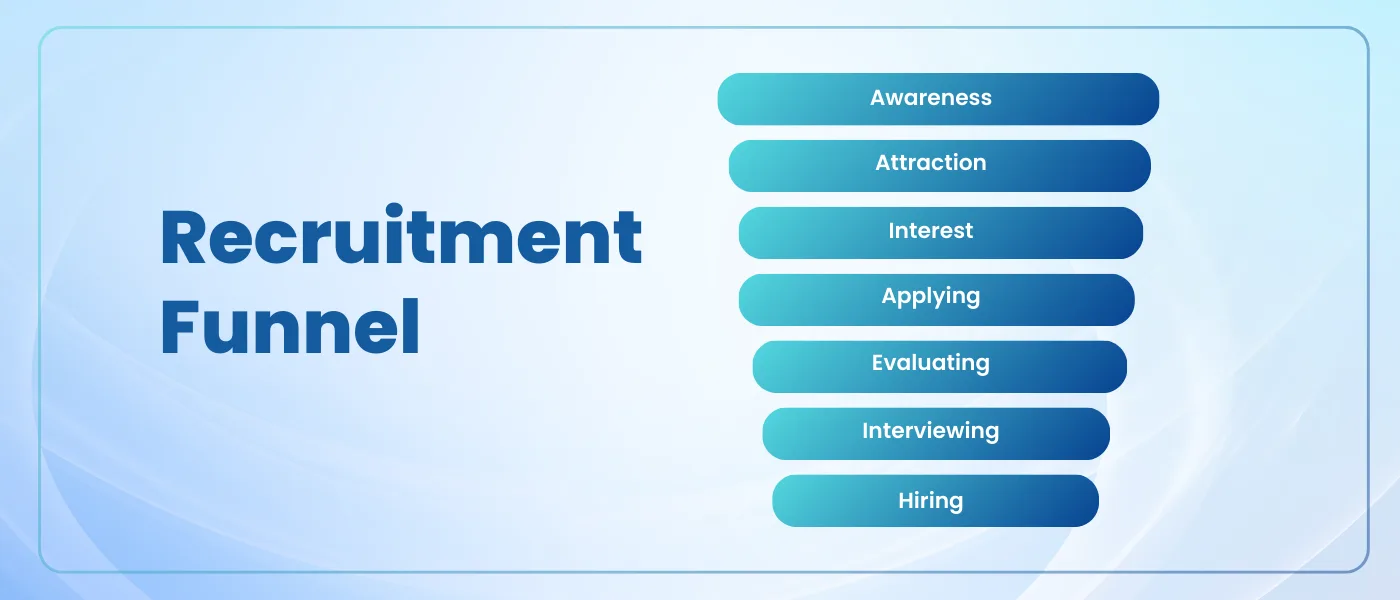
The stages can differ by team, but the purpose stays the same: show where candidates enter, where they stop, and what action may improve the process.
Stages of a recruitment funnel
01Awareness
Candidates learn that your company and roles exist through a careers page, job boards, referrals, search, social media, or community events. Use a clear careers page and post jobs where your target candidates look. Measure whether the people you want are seeing the role.
02Attraction
The job message gives candidates a reason to continue. A strong job description explains outcomes, responsibilities, schedule, location, pay where appropriate, and the experience the team expects. The job description best-practices guide can help the team review the draft.
03Interest
Candidates research your company, organizational culture, reviews, team, and process. Answer practical questions on your website, including the Recooty homepage, and give candidates a way to ask for clarification.
04Applying
The application should collect what the team needs without making every candidate repeat information. Keep it mobile-friendly, remove duplicate fields, and tell candidates what happens next. An applicant tracking system (ATS) can keep applications in one place. Recruiters can also use candidate sourcing ideas when the role needs a wider audience.
05Evaluating
Recruiters review applications against job-related criteria and may use a screen, work sample, or phone conversation. Resume parsing can organize information, but missing keywords should not be treated as proof that a candidate cannot do the work.
06Interviewing
Use structured questions and a shared scorecard. Too many rounds drain candidates, while an unstructured conversation makes comparison difficult. Each round should have a purpose and a decision owner.
07Hiring
Make the offer clear and give the candidate a way to discuss the work, manager, schedule, benefits, and compensation. Candidate goals and competing offers may affect acceptance, so respond promptly and document the decision.
Software for the recruitment process
Recruitment software can centralize applications, distribute jobs, automate reminders, organize resumes, schedule interviews, and report stage performance. Start by defining the question each stage should answer before configuring an ATS.
| Funnel stage | Question | Metric to watch | Action when the signal changes |
|---|---|---|---|
| Awareness | Are the right people seeing the role? | Qualified reach | Improve distribution or audience targeting |
| Attraction | Does the message make the role worth exploring? | Job-view engagement | Clarify outcomes, pay, location, or growth |
| Applying | Is the application proportionate? | Start-to-complete rate | Remove duplicate fields and test mobile flow |
| Evaluating | Are screens finding job-related evidence? | Qualified-screen rate | Review criteria and edge cases |
| Interviewing | Are interviews consistent and useful? | Completion and feedback time | Use structured questions and training |
| Hiring | Are finalists accepting and succeeding? | Offer acceptance and 90-day retention | Review role clarity and selection quality |
The formula for stage conversion is candidates who advance divided by candidates who enter, multiplied by 100. Define each stage consistently. If one recruiter marks a screen complete when it is scheduled and another waits for submitted feedback, the dashboard will mislead the team.
The two-layer funnel dashboard
Pair behavioral data with perception and outcome data. Behavioral data shows where candidates move or stop. Candidate surveys, recruiter notes, hiring-manager feedback, quality of hire, and early retention help explain why.
Review active roles weekly and process trends monthly or quarterly. Keep definitions stable, but compare similar roles. A chef, software engineer, and entry-level support role have different sourcing pools and assessment requirements. When reviewing stakeholder expectations, define each stakeholder's decision and the KPIs they need to see.
How an ATS should support the funnel
Use stage names that reflect decisions rather than internal jargon. Add required fields for source, disposition reason, interview feedback, and next action. Automate reminders and updates while keeping a human route for sensitive questions and accessibility needs.
Useful capabilities include job distribution, source tracking, a mobile-friendly careers page, structured interview kits, scorecards, stage reporting, and communication templates. The employer-branding guide can help connect the top of the funnel to the candidate experience. The system should reduce duplicate work and show who needs to act next.
How to build a recruitment funnel
Start with the role and work backward from the hiring decision:
- Define the outcomes, essential skills, and evidence the role requires.
- Choose stages that represent real decisions, such as screen complete or interview feedback submitted.
- Assign an owner and service-level target to each stage.
- Add a metric that shows speed and another that shows quality or candidate experience.
- Review results by role, source, seniority, location, and hiring volume.
- Test one change, then check the downstream effect before making another.
Connect the funnel to the recruitment process guide, job offer letter sample, and guidance on avoiding discrimination in hiring.
When a smaller funnel is healthier
Every fall in volume is not a leak. Some filtering is healthy when a role attracts people who do not meet a clearly stated requirement. The useful question is whether the drop-off happens for the right reason and at the right cost.
For example, a lower application completion rate may be acceptable if a shorter, clearer screen produces a stronger qualified slate. A high interview-to-offer rate may also mean the team interviewed too few people or used an overly narrow screen. Review the stage with downstream quality, fairness, offer acceptance, and candidate feedback before changing it.
Use this diagnostic sequence:
- Locate the first stage where volume, speed, or sentiment changed.
- Segment the result by role family, source, geography, seniority, device, and candidate group where lawful.
- Read candidate comments, recruiter notes, and hiring-manager feedback alongside ATS events.
- Change one variable, such as job copy, application length, screening questions, or interview rubric.
- Check whether quality, fairness, offer acceptance, or retention changed afterward.
SHRM's quality-of-hire guidance recommends agreeing on hiring outcomes before interviews begin. A funnel should connect to early performance, retention, hiring-manager satisfaction, and candidate experience rather than stop at the offer letter.
A practical funnel review
Choose one active role and review its stages this week. Confirm that every stage has a clear owner, record the first avoidable delay, and test one small change. Recheck the qualified slate and candidate feedback before deciding whether the funnel improved.
Frequently Asked Questions
What is the most important recruitment funnel metric?
There is no single best metric. Start with stage conversion and time in stage, then connect them to offer acceptance, candidate experience, early retention, and quality of hire.
How do you fix a recruitment funnel bottleneck?
Find the first stage where performance changes, segment the result by role and source, collect candidate and hiring-manager feedback, and test one process change. Recheck downstream quality before declaring the bottleneck fixed.
What is a good recruitment funnel conversion rate?
A useful rate depends on role, source, location, seniority, and screening design. Use your own historical baseline and compare like with like instead of importing a generic benchmark.
How can recruitment software improve a hiring funnel?
It can centralize applications, distribute jobs, automate reminders, organize resumes, standardize scorecards, and report stage performance. It helps only when stages and decision rules are defined clearly first.
How often should you review a recruitment funnel?
Review active roles weekly so delays can be corrected while candidates are available. Review the full process monthly or quarterly to identify source quality, fairness, candidate experience, and early-retention patterns.
Research sources
- SHRM 2026 Talent Trends on skills shortages and talent strategies.
- SHRM recruiting benchmark data brief for recruiting benchmark definitions.
- LinkedIn Future of Talent 2026 on skills, learning, and workforce planning.
Practical recruiting playbooks, HR tutorials and hiring trends from the team behind Recooty — hiring software for growing teams.