Top ATS for Healthcare Businesses in the USA 2026
Explore the Top ATS for Healthcare Businesses in the USA in 2026! Learn how these tools streamline hiring the process. Discover the best options now!
CONTENTS
- 00Introduction
- 01Key takeaways
- 02What is an ATS?
- 03What does an ATS do?
- Job Posting and Distribution
- Resume Screening and Parsing
- Applicant Tracking and Management
- Candidate Communication and Engagement
- Automated Interview Scheduling
- Reporting and HR Analytics
- 04Top ATS for Healthcare Businesses in the USA
- Recooty
- iCIMS
- Greenhouse
- Lever
- SmartRecruiters
- 05How to compare healthcare ATS options in practice
- 06Conclusion
- 07Frequently Asked Questions
Healthcare employers need an ATS that can handle high application volume while keeping licenses, certifications, interview feedback, and candidate communication easy to review. The five platforms below serve different team sizes, so compare credential workflows, integrations, access controls, reporting, and total cost with a real healthcare vacancy.
The American Hospital Association has described serious workforce pressure in a healthcare workforce report. An ATS can reduce recruiting administration, but it does not replace a qualified review of clinical credentials or your organization's compliance process.
This guide explains what an ATS does and how to compare five options for healthcare businesses in the USA.
Key takeaways
- Prioritize license and certification checks, structured scorecards, interview scheduling, and clear candidate communication.
- Confirm integrations with HRIS, background-check, credentialing, and onboarding tools before you choose.
- Test permissions, retention, exports, audit logs, and the handling of sensitive candidate information.
- Treat AI screening as decision support and keep qualified people responsible for selection decisions.
- Pilot one clinical and one non-clinical role so the system works across your hiring mix.
What is an ATS?
An Applicant Tracking System (ATS) is a digital recruitment tool that provides a central system for HR teams to manage the entire hiring process faster, smarter, and more efficiently from beginning to end.
An ATS is used for optimizing every stage of the recruiting process, from creating job postings and collecting and managing resumes to interviewing and communicating with candidates. All of this is streamlined, stored, and tracked in one place.
For healthcare businesses with many open roles, an ATS stores candidate information, surfaces relevant qualifications such as licenses or certifications, and moves candidates through a hiring pipeline for manager review.
Furthermore, all of the hiring team, including recruiters, department heads, etc., can see the same candidate information at the same time, in one centralized hub.
What does an ATS do?
An ATS can offer a plethora of features, including simple resume databases to advanced features like automated interview scheduling, AI-powered candidate matching, and detailed hiring analytics. These features can also be customized based on the healthcare business’s hiring needs and budget. However, these are some of the basic features that an ideal ATS offers.
Job Posting and Distribution
With an ATS, recruiters can create detailed job ads and post them to multiple job boards, career sites, and social media channels at the same time. By automating distribution, an ATS helps a vacancy reach more potential applicants.
This can increase reach. Some ATSs also offer optimized and customized job description templates that save time and reduce avoidable errors.
Resume Screening and Parsing
An ATS can scan a resume for relevant keywords or qualifications and parse the information into a standardized candidate profile. This speeds up an initial review, but recruiters should check parsing and screening results before rejecting an applicant.
Applicant Tracking and Management
As its name suggests, the fundamental job of an ATS is applicant tracking. But it does a whole lot more than merely display where a candidate is in the pipeline. It allows hiring teams to build hiring workflows that move every candidate through each stage of the application process, right from application to hiring and even onboarding in some cases.
You can define steps such as phone screening, technical interviews, background checks, and offer letters, all in one central platform. This encourages openness, minimizes blockages, and maintains everyone on the same page.
It also reduces the chance that a candidate waits weeks without an update, a common problem in manual processes.
Candidate Communication and Engagement
A good ATS will keep on communicating and interacting with candidates irrespective of where they stand in the hiring flow. Most ATSs will typically allow you to send auto emails, application status, and other notifications to the candidates without any difficulty.
This helps your team keep communication clear and improves the candidate experience.
Automated Interview Scheduling
Setting up interviews can be a real headache when you’re trying to hire people if your team works in shifts or has unpredictable hours. An ATS makes this job easier by connecting to the calendars of both recruiters and job seekers.
It shows when people are free in real time and even lets candidates pick a time that works for them. This cuts down on all those back-and-forth emails and helps you hire faster, which is great when you need to fill jobs or have positions that often need new people.
Most of the time, the ATS will also send out reminders and confirmations on its own, which means fewer no-shows and last-minute changes.
Reporting and HR Analytics
Most ATS platforms provide analytics dashboards with recruiting metrics such as time-to-fill, source of hire, cost-per-hire, and application drop-off.
This information enables recruiters to make better choices. For example, if your data indicates that applications from one job board yield higher-quality candidates, you can invest more in that system.
Or, if the critical hiring time is taking too long, you can identify where bottlenecks are forming and implement process improvements.
Top ATS for Healthcare Businesses in the USA
Here is a list of the best 5 Applicant Tracking System for healthcare businesses in the USA. We have carefully curated this list, keeping in mind that they are pocket-friendly and include all the above features and additional features as well.
01Recooty
Recooty
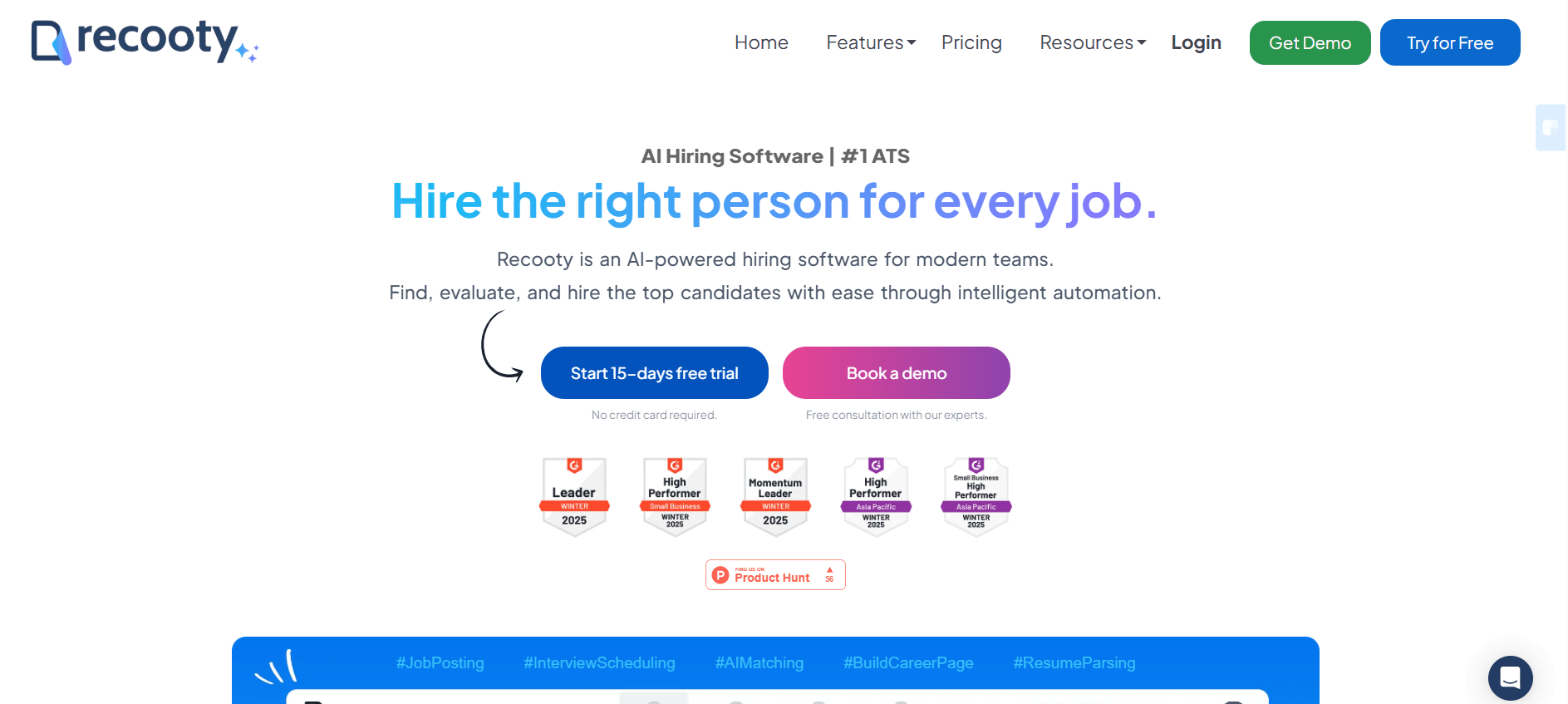
is a modern, AI-powered applicant tracking system that optimizes the entire hiring process for small and medium-sized businesses.
The straightforward and easy-to-use user interface allows healthcare organizations to post jobs to over global job boards
without any hassle, including major platforms like Indeed and LinkedIn.
Recooty helps you simplify job posting and candidate tracking, build customizable, branded career pages, schedule interviews, and draft job descriptions with AI tools.
Recooty is GDPR and ISO 27001 compliant, creating a safe place for sensitive healthcare institution data.
In terms of recognition, Recooty has received awards for its awesome performance and top-notch customer service.
The SoftwareSuggest assessment awarded Recooty the High Performer and Customer Support badges for Winter 2026. This is important to us in terms of Veterans of the US workforce.
Also, Recooty has been rated as #1 Recruitment Software in 2026 and 2026 by Gartner. Also, reached a milestone of being recognized as ‘Users Love Us’ on G2 in 2026.
Hence, Recooty is proven to be a reliable ATS solution for healthcare businesses aiming to streamline their recruitment efforts.
02iCIMS
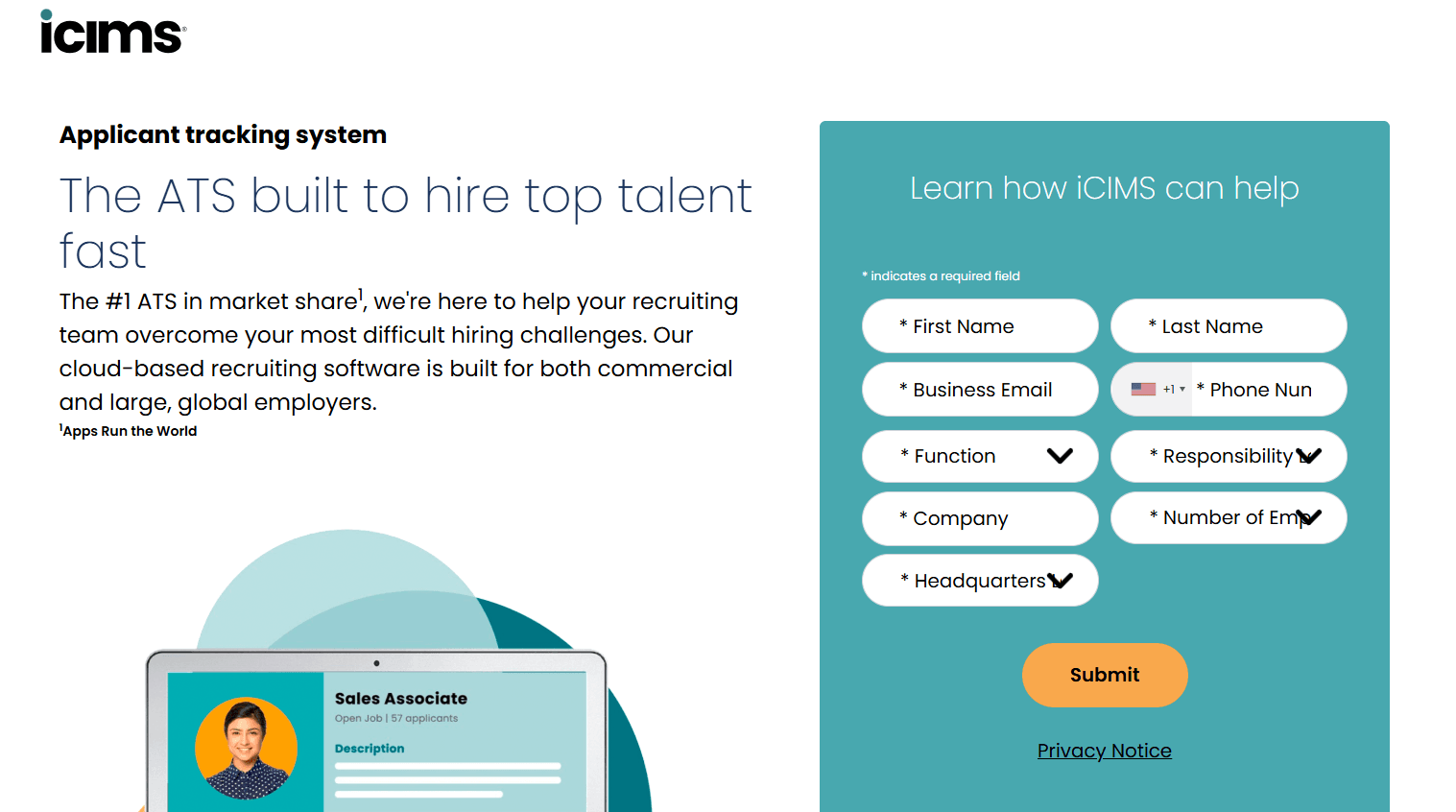
iCIMS is an established innovator in hiring technology, with a strong platform to address the recruitment requirements of highly complex industries like healthcare. With ease of customization and high level of integrability, iCIMS is helping large healthcare businesses to efficiently attract, engage, and hire top talent.
Its most in-demand feature is iCIMS Talent Cloud which unifies every stage of the talent life cycle from sourcing and engagement to onboarding and career mobility.
iCIMS was named a Leader in the 2026 Gartner Magic Quadrant for Talent Acquisition Suites and holds high positions on both G2 and TrustRadius for enterprise ATS capabilities consistently.
iCIMS is also a SHRM Preferred Provider and partner to over 800 US healthcare systems, including Mayo Clinic and Johns Hopkins Health.
With its history of scalability, compliance, and interdepartmental integration, iCIMS is an ideal choice for healthcare businesses that want to modernize their hiring while maintaining operational excellence.
03Greenhouse
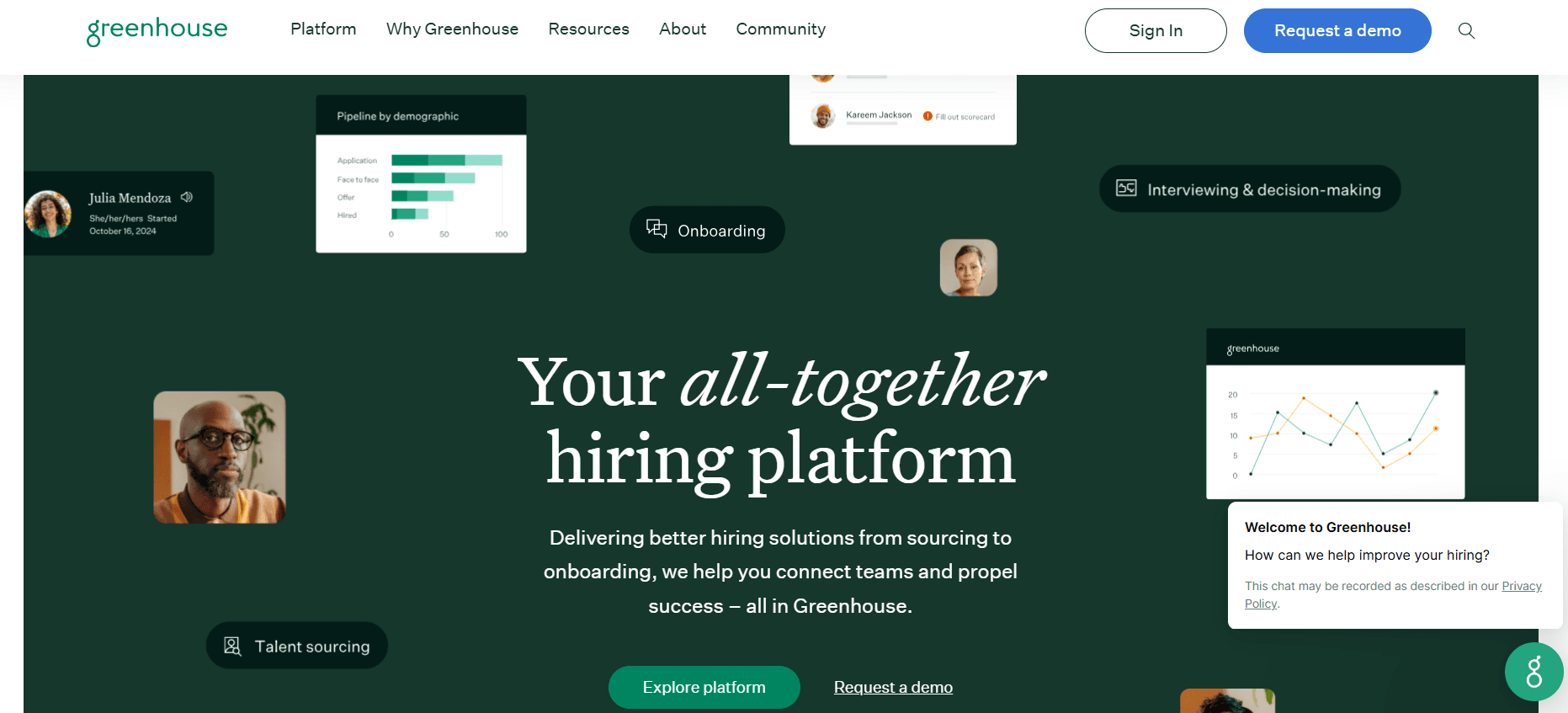
Greenhouse is a robust, enterprise-level ATS platform suitable for healthcare institutions with complicated staffing requirements.
Its scalability and collaboration features make it suitable for helping healthcare recruiters to minimize bias, develop structured interview kits in the hiring process, and enhance candidate quality through its advanced pipeline management tool.
The system also includes intelligent integrations with HRIS, background screening, scheduling software, and telehealth communications platforms for efficient recruiting workflows from job post through hire.
In recognition, Greenhouse has secured its place among the best-rated ATS platforms on G2, which recognized it as a Leader in the Applicant Tracking Systems category for Winter 2026.
It also received the 2026 Tech Cares badge for demonstrating a consistent dedication to employee diversity and ethical hiring.
These differences attest to Greenhouse’s reputation for facilitating fair, data-informed hiring, especially important for healthcare employers looking to hire diverse teams that mirror the communities they serve.
04Lever
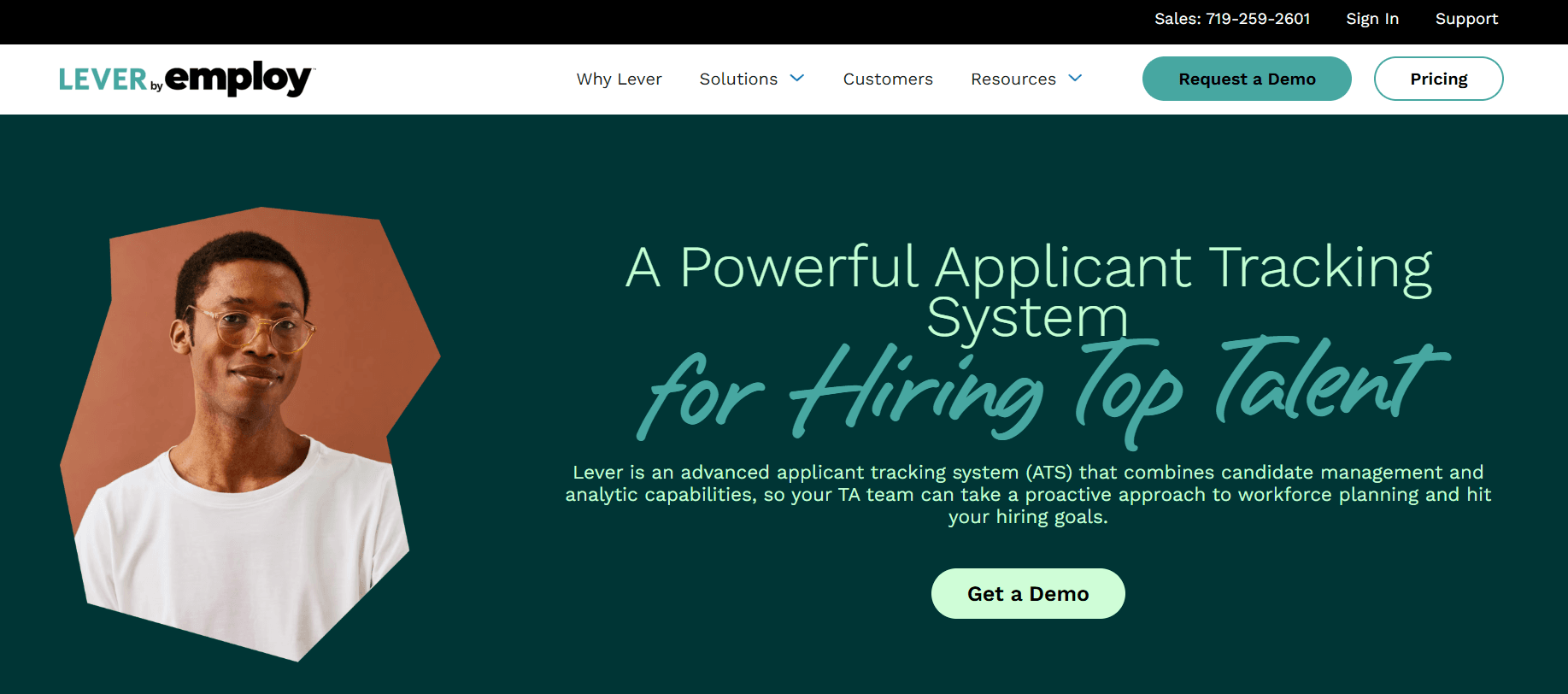
Lever is a cloud-based talent acquisition suite that combines applicant tracking with CRM capabilities, which is especially useful for healthcare providers that want to proactively engage with talent ahead of the need to hire.
Lever’s intuitive UI makes it easy for recruiters and hiring managers to handle job requisitions, manage candidate pipelines, and decrease time-to-hire from one central platform.
Lever’s tools enable healthcare organizations to see into sourcing trends, monitor compliance metrics, and provide a more strategic candidate experience.
Lever has earned numerous awards for ease of use and customer satisfaction. It was recently recognized as a Leader on G2’s 2026 Grid for Mid-Market ATS Software and ranked in Forrester’s Wave Report as one of the most robust platforms for end-to-end hiring.
Lever also has a high customer satisfaction rate among clients in regulated sectors such as healthcare, owing to its robust data privacy practices, scalable workflows, and ease of use.
For healthcare companies looking to customize the candidate experience while adhering to stringent regulatory requirements, Lever is a reliable, forward-looking solution.
05SmartRecruiters
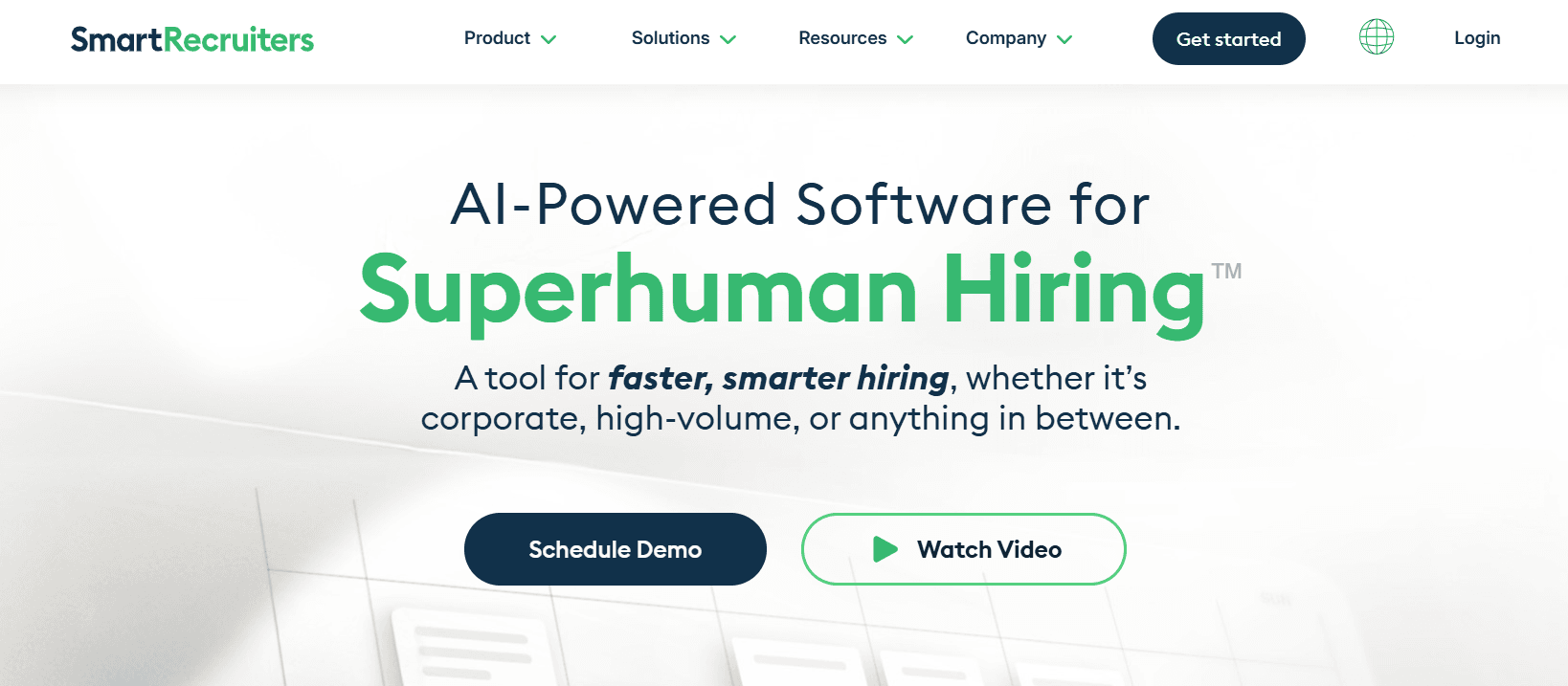
SmartRecruiters is an AI-driven hiring platform with tools for job promotion, candidate screening, offer management, and onboarding in one workflow.
The Smart Assistant AI feature in the platform intuitively ranks resumes and eliminates unconscious bias, so healthcare recruiters can concentrate on quality rather than quantity.
The platform also facilitates multi-location recruiting and multi-language support, making it ideal for large hospital chains and research organizations with varied staffing requirements.
SmartRecruiters has received acclaim for its scalability and innovation, winning the TrustRadius Top Rated Award in 2026 and being named a Market Leader in IDC’s Talent Acquisition report.
It is also highly ranked on G2 for enterprise recruitment and global compliance, and thus a top choice for healthcare organizations that must comply with HIPAA, GDPR, and other sensitive data regulations.
With collaborative hiring, interview automation, and integrations with healthcare tools, SmartRecruiters can help HR teams coordinate hiring work. The team still needs to verify each candidate's qualifications.
How to compare healthcare ATS options in practice
Run the same clinical and non-clinical vacancy through each finalist. Submit resumes with different layouts, record how the system captures licenses and certifications, test recruiter and manager permissions, schedule a shift-based interview, send a candidate update, and export or delete a sample record. Review every AI recommendation against the job requirements and document who made the final decision.
This comparison shows whether a platform supports the work healthcare recruiters actually do. It also surfaces missing integrations, manual corrections, unclear reports, and access problems before they affect a live hiring process.
Conclusion
A majority of healthcare businesses are digitizing their hiring process by adopting recruitment tools like ATS to attract top talent and streamline their hiring process.
Selecting an ATS can improve hiring administration for healthcare businesses, where teams often need to fill roles quickly and verify specialized qualifications.
Platforms such as Recooty AI, Lever, iCIMS, SmartRecruiters, and Greenhouse offer different combinations of recruiting automation and collaboration tools.
They may also connect to job boards and other HR tools. Choose the platform that fits your roles, review process, integrations, and data controls, then validate that choice in a pilot.
Use the latest recruiting trends as context, but base the final decision on evidence from your own hiring workflow.
Frequently Asked Questions
What is an ATS in healthcare recruiting?
An Applicant Tracking System is software that helps healthcare organizations collect applications, review candidates, manage hiring stages, schedule interviews, and communicate with applicants.
Why do healthcare firms need an ATS suited to their hiring process?
Healthcare teams often hire across clinical and non-clinical roles, verify licenses or certifications, and coordinate many reviewers. An ATS can keep those steps visible and consistent, but it does not replace credential or compliance judgment.
Will an ATS ensure compliance in healthcare recruiting?
An ATS can support compliance with permissions, audit trails, retention controls, structured criteria, and documented workflows. Your organization remains responsible for choosing job-related criteria and applying its legal and regulatory requirements.
What features should healthcare organizations review?
Review credential and certification fields, resume parsing, structured scorecards, background-check and HRIS integrations, interview scheduling, mobile access, reporting, permissions, data export, and support.
Are ATS solutions available for small healthcare businesses?
Yes. Many vendors offer plans that can scale with a smaller healthcare team. Test setup time, user limits, support, integrations, and total cost before selecting a plan.
Source: https://recooty.com/blog/top-ats-for-healthcare-businesses-in-the-usa/
Practical recruiting playbooks, HR tutorials and hiring trends from the team behind Recooty — hiring software for growing teams.